AI in 2026 needs binding regulation because Bill Gates calls it more dangerous than nuclear weapons
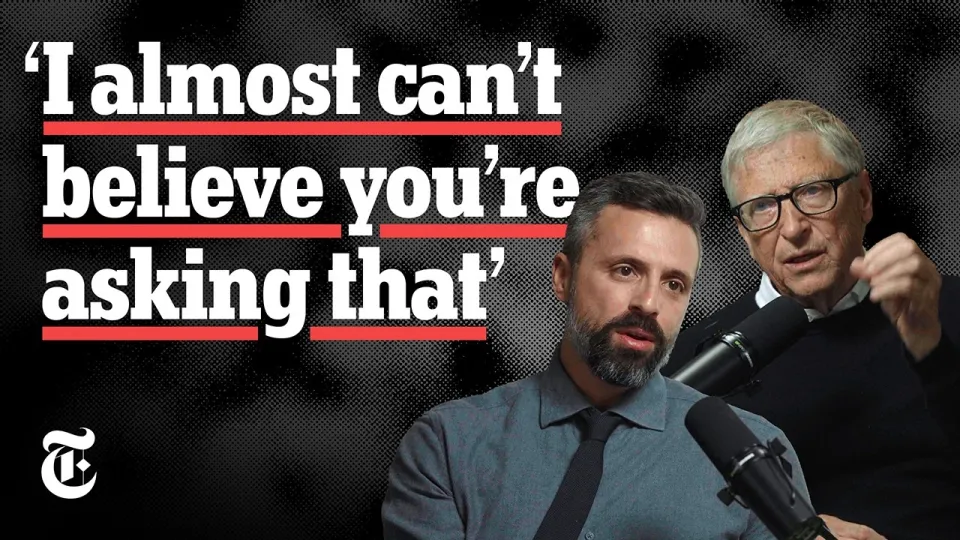
Video: Bill Gates: A.I. ‘Makes Nuclear Weapons Look Like Nothing’ | The Ezra Klein Show
You can order the same kind of articles for your own video to boost it on YouTube and Google. Just message the Telegram bot @sat_sit_bot. The bot writes and publishes the articles itself (with your YouTube video embedded) on popular topical websites (no ads). Your first 50 articles are free.
· based on the channel The Ezra Klein Show
In 2026, the case for binding AI regulation rests on a blunt claim from Bill Gates: artificial intelligence is more dangerous than nuclear weapons, and the industry cannot police itself. Speaking on The Ezra Klein Show, Gates argues that catastrophic cyberattacks, bio-terrorism and mass job loss are realistic near-term outcomes unless governments write and enforce rules. The full conversation and transcript are available through The Ezra Klein Show episode page.
What Gates actually said about AI risk
Gates, the co-founder of Microsoft and chair of the Gates Foundation, did not arrive at alarmism casually; he describes having once been a skeptic of worst-case AI scenarios. That changed as he watched model capabilities compound. His framing is comparative rather than abstract: nuclear weapons are physical, countable and governed by treaties, while AI is software that can be copied, fine-tuned and deployed by almost anyone. That combination — enormous capability plus near-zero deployment cost — is what makes the risk category different.
Ezra Klein pressed him on whether this was rhetorical overreach. Gates held the line, arguing that the people in positions of authority are in denial about what is coming. The interview is notable for its tone: Gates is visibly agitated, pushes back on questions he considers too soft, and does not soften his language for the audience.
The two thresholds Gates says we are not ready for
Gates points to two specific thresholds where AI capability turns into civilian catastrophe, and neither is speculative in his account.
- Cyber. Offensive tooling that can find and exploit vulnerabilities at machine speed and scale, outpacing human defenders and the patch cycles of critical infrastructure.
- Bio. The narrowing gap between digital design and physical synthesis, where model output could lower the barrier to producing dangerous biological agents.
His argument is that both are asymmetric: a single actor needs one success, while defenders need to prevent every failure. Existing liability frameworks are built for products that fail one unit at a time, not for tools whose failure mode is measured in millions of people.
Why Gates calls AI self-regulation "insane"
The sharpest moment in the conversation is Gates dismissing the idea that AI labs will regulate themselves. His reasoning is structural, not personal: companies compete on capability and speed, so any voluntary restraint is a handicap against rivals who decline to match it. He also rejects the litigation model outright — the notion that harm will be corrected after the fact through lawsuits. In his words, roughly, if something kills 100 million people, you are not going to deal with that through a lawsuit.
That position puts him at odds with figures such as Nvidia's Jensen Huang, who has argued that market incentives and reputational pressure will push AI companies toward safety. Gates's counter is that capitalism supplies incentives to ship, not to pause, and that every major industrial harm of the past century required regulation rather than voluntary codes.
The China race and the case for government safety floors
Gates treats the AI race with China as an argument for regulation, not against it. If safety is a unilateral cost, the firm or country that moves fastest wins and the careful one loses. The fix he describes is a shared floor — rules that apply to everyone in a jurisdiction, so no competitor gains by cutting corners.
The same logic extends to frontier models trained abroad. Gates's implicit point is that domestic rules without international coordination simply relocate risk rather than reduce it, which is why he wants governments, not boardrooms, setting the terms.
Jobs, inequality and a labor market without scarcity
On employment, Gates is more optimistic than on security but still expects disruption. He sketches a labor market where AI drives the marginal cost of cognitive work toward zero, producing what he describes as a no-scarcity job market — abundance in output alongside a wrenching transition for workers whose skills are suddenly commoditized.
He raises taxing AI labor as a serious policy question rather than a slogan, and floats the idea of "human reserved" jobs — roles where society deliberately requires a human in the loop, much as it does in some safety-critical and care settings. He also flags the risk that gains concentrate in rich countries, widening the gap with developing nations that lack compute, data and capital.
Common questions viewers raised about the interview
The reaction to the episode clustered around a few recurring doubts, and they are worth addressing directly.
- Was Gates exaggerating for effect? The comparison to nuclear weapons is his framing device, but the underlying claim is about deployment cost and copyability, not blast radius.
- Does regulation mean a moratorium? Gates argues for thresholds and licensing tied to demonstrated capability, not a blanket stop.
- Why trust a tech billionaire on this? His answer is that his foundation's exposure to global health and development gives him a view of downstream harm that labs do not price in.
- What about education? Gates links AI in classrooms to learning loss in rich countries and calls for age-specific safeguards for children.
Where the Gates Foundation fits
Gates frames AI-driven inequality as a new priority for the Gates Foundation, which he says is set to spend down roughly $200 billion over the next two decades. The bet is that AI can be directed toward problems markets ignore — health, agriculture, language access for underserved communities — rather than only toward productivity gains that accrue to whoever already owns the compute. He is explicit that this is a choice, not an automatic outcome.
Useful links
- Full episode and transcript of Bill Gates on The Ezra Klein Show
- Book recommendations from guests of The Ezra Klein Show
The bottom line on AI regulation
Gates's position is that AI is the most dangerous technology humanity has approached, and that the current reliance on voluntary restraint is a category error. His prescription is unglamorous: government-set safety thresholds, licensing tied to demonstrated capability, international coordination so no competitor gains by cutting corners, and deliberate policy for the labor transition. Whether or not you accept the nuclear comparison, the interview is a useful stress test of the self-regulation argument, and it is hard to watch without noticing how much of the industry's defense rests on the assumption that harm will be correctable after the fact. This analysis draws on the conversation published by The Ezra Klein Show; the full episode and transcript are available at https://www.nytimes.com/2026/09/29/opinion/ezra-klein-podcast-bill-gates.html.
Key takeaways
- Gates calls AI the most dangerous technology humanity has approached, ranking it above nuclear weapons in risk.
- He names two near-term thresholds — catastrophic cyberattacks and bio-terrorism — that current oversight cannot handle.
- Gates calls the idea that AI companies can self-regulate "insane" and argues lawsuits are no answer to mass-casualty risk.
- He frames the AI race with China as a reason for governments, not companies, to set safety floors.
- Gates says the Gates Foundation will spend down roughly $200 billion over two decades, with AI-driven inequality as a new priority.
Source: Bill Gates: A.I. ‘Makes Nuclear Weapons Look Like Nothing’ | The Ezra Klein Show · Markdown version
Questions & answers
Why does Bill Gates compare AI to nuclear weapons?
Gates uses the comparison to make a point about scale rather than physics. Nuclear weapons are countable and governed by treaties, while AI is software that can be copied and deployed almost anywhere at near-zero cost. In his view, that combination of capability and accessibility makes AI a harder risk to contain than any previous technology.
What does Gates mean when he says AI self-regulation is insane?
He argues that companies competing on capability cannot credibly restrain themselves, because voluntary limits become a handicap against rivals who decline to match them. His alternative is government-set rules that apply to every firm in a jurisdiction, so safety stops being a competitive disadvantage.
Which risks does he consider most urgent?
Gates names catastrophic cyberattacks and bio-terrorism as the two thresholds where AI capability turns into mass-casualty risk. Both are asymmetric, meaning a single attacker needs one success while defenders must prevent every failure, and current liability frameworks are not built for that.
What does Gates propose for jobs and inequality?
He expects AI to push the marginal cost of cognitive work toward zero and describes a transition toward a no-scarcity job market. He raises taxing AI labor and creating human-reserved roles as policy options, and says the Gates Foundation will treat AI-driven inequality as a priority as it spends down roughly $200 billion over two decades.